

Deendayal Port (formerly Kandla Port) is India’s largest liquid-cargo handling port. Its line of oil jetties handles a substantial share of the country’s POL traffic. Oil Jetties 1, 2 and 4 are amongst the older berths in the system, and like all marine concrete structures they are exposed to one of the harshest service environments engineering structures encounter – tidal wetting and drying, chloride ingress, and continuous mechanical loading from berthing tankers.
BuildAid was engaged to carry out a detailed condition assessment of the three jetties and to recommend a retrofitting and corrosion-protection strategy that would extend their service life while keeping them in operation.
Marine oil jetties pose a uniquely difficult diagnostic problem. The deck slab, beams, pile caps and piles are simultaneously subject to chloride-induced corrosion in the splash and tidal zones, restricted access due to continuous tanker operations, and tight tidal windows for underwater inspection. The investigation had to combine above-water surveys, tide-coordinated below-deck work, and underwater inspection of submerged piles.
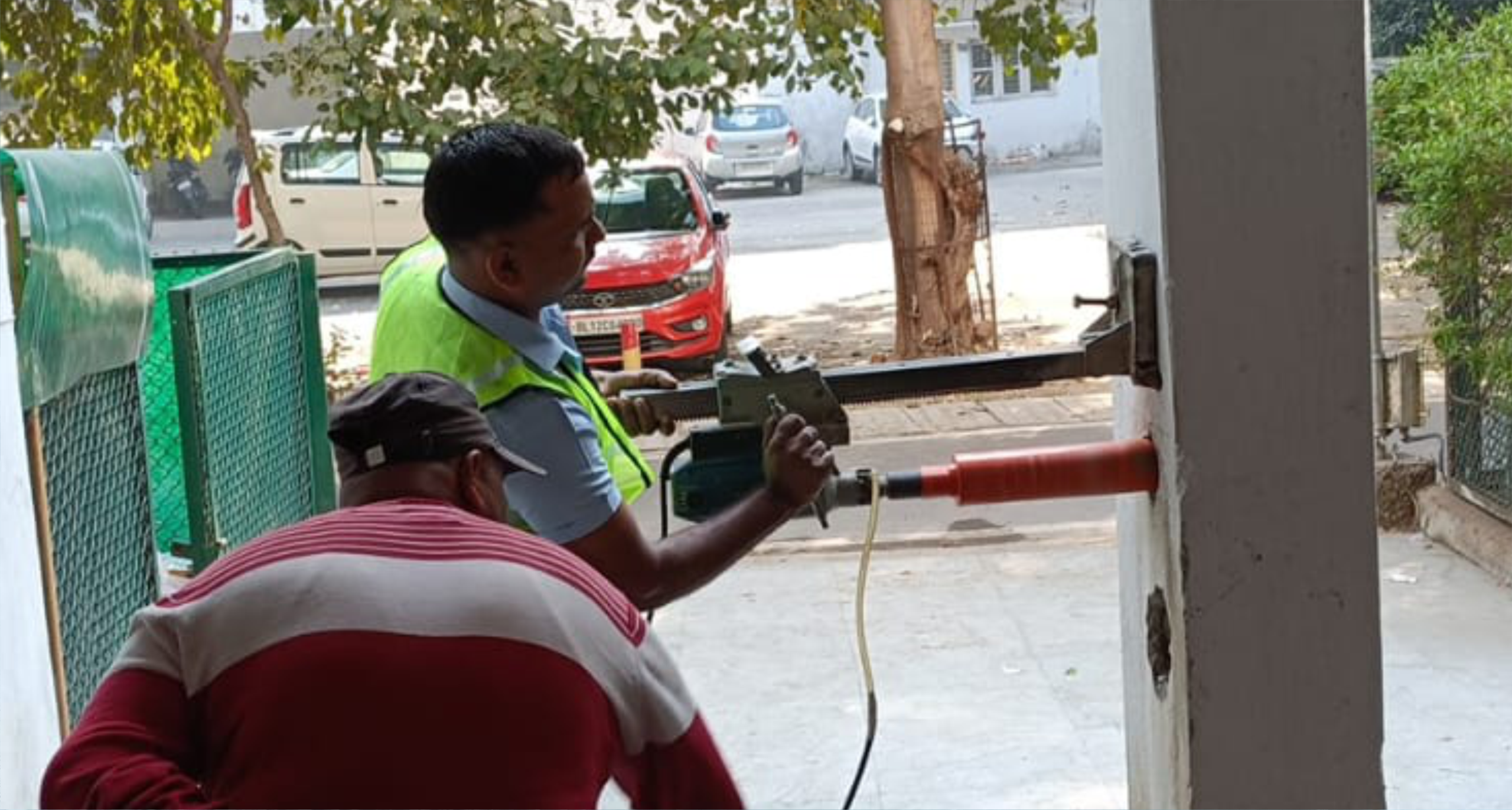
BuildAid deployed its specialised corrosion-diagnostics toolkit: visual distress mapping; chloride and sulphate profiling at multiple depths; carbonation depth checks; half-cell potential mapping across the deck and substructure; resistivity profiling; cover-meter scanning; UPV; rebound hammer; and core extraction for compressive strength and petrography. Underwater inspection of pile elements was undertaken by trained divers, supported by photographic and dimensional recording. Results were synthesised into a corrosion-severity model that fed into the residual-life calculation.